
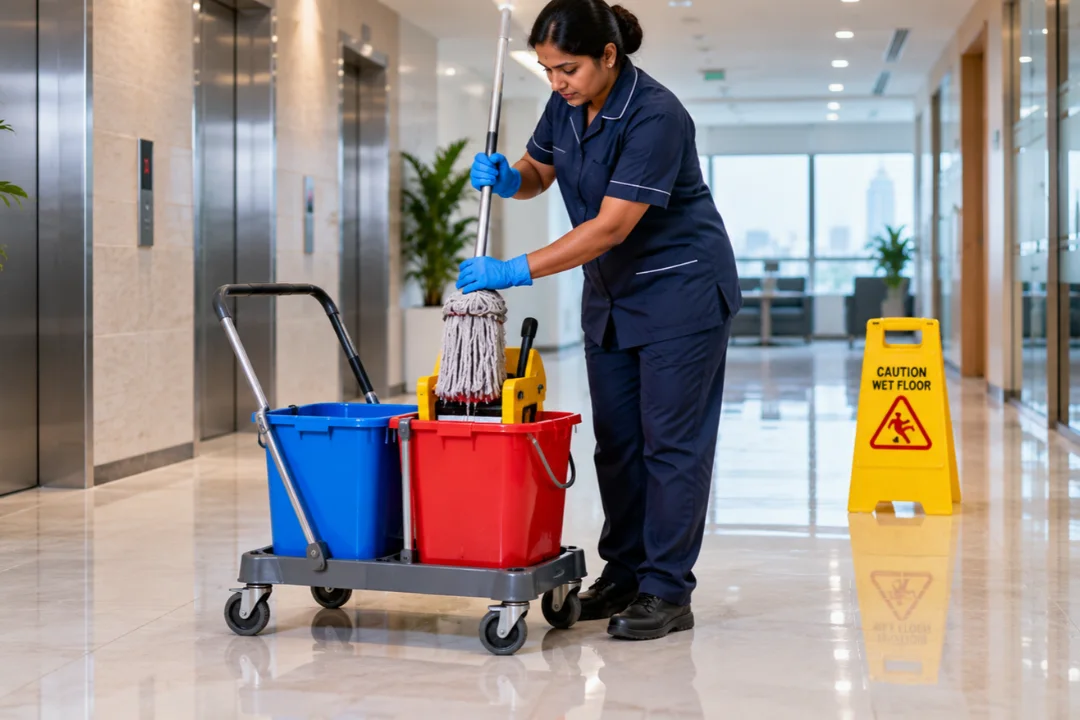
Double Bucket Mopping Method: A Step-by-Step Guide
A mop that goes back into grey water spreads the same dirt onto the next tile. The double bucket mopping method breaks that loop with a simple split. One bucket holds a clean solution; the other collects what you wring out. The mop head only returns to clean water, so every pass starts fresh. Below you will find the setup, the steps, and how to match equipment to the space you clean.
Table Of Contents:What Does a Two-Bucket Setup Needs?
Start with the gear, because a method is only as easy as the equipment behind it. A basic kit needs two buckets, a mop, a wringer and somewhere to keep it all. A trolley puts those pieces on one set of wheels, so you are not hauling a full bucket in one hand and a mop in the other.
Material affects daily handling. Polypropylene and high-density polyethylene are both used by plastic manufacturers in UAE for handling products, and the mop trolleys covered below are polypropylene. Some add a reinforced metal handle. Colour coding helps too. One 85 litre double bucket model uses blue for clean water and red for dirty water, which removes the guesswork halfway down a corridor.
The Double Bucket Mopping Method, Step by Step
- Before any water comes out, clear chairs, cables and loose items, and set a wet floor sign where people will see it.
- Sweep or dust-mop the floor. Wet mopping over loose grit only drags it around.
- Fill one bucket with water and detergent, following the dilution directions on the label. The second bucket stays empty for now. Different cleaning products should never be combined.
- Dip the mop into the clean bucket, then wring it over the dirty one until it stops dripping.
- Work in sections, starting at the far end and backing toward the exit, so you never step on a finished floor.
- Once the mop head picks up visible dirt, rinse and wring it in the dirty bucket, then return to the clean side for a fresh solution.
- Leave the sign up until the floor dries. Rinse the buckets and mop heads, and let them dry before storage.
When to Change the Water
There is no fixed schedule. A busy entrance clouds the water faster than a small office does. Swap it when the clean bucket turns murky or the dirty bucket fills. Empty the dirty one first, rinse it, then refill both.
Picking a Trolley by Space and Workload
The double bucket mopping method works at any scale, but the hardware changes with the floor. The cleaning trolleyssupplier in UAE will usually group its range by setting: offices and shops, hotels and hospitals, schools and malls, and factories and warehouses.
Small and Mid-Size Areas
Single bucket mop trolleys come in 20 and 25 litres. The 20-litre unit measures 360 by 270 by 670 mm, and the 25-litre unit 450 by 310 by 760 mm. For a full two-bucket routine, the double bucket models are the closer fit. The 30-litre version measures 530 by 300 by 900 mm, and the 50-litre version 670 by 400 by 900 mm.
Larger Floors
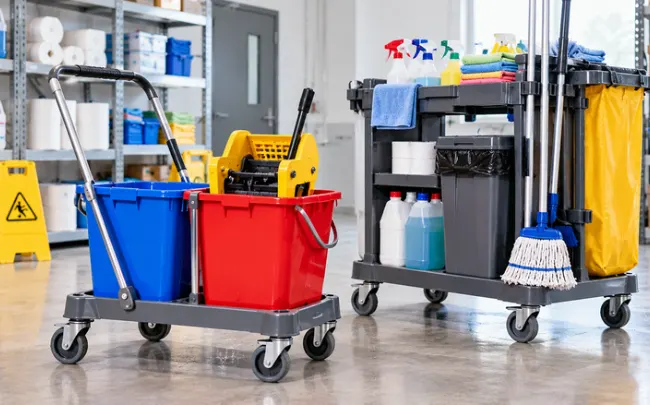
The 85 litre double bucket trolley measures 850 by 500 by 950 mm, with the total capacity split between its two buckets. Multipurpose trolleys go bigger. The 80-litre model measures 1200 by 500 by 1150 mm, and the 85-litre model 1330 by 680 by 1140 mm. They hold mops, buckets, detergents and waste bins together, so one trip covers the whole job.
Three questions narrow the choice: what kind of cleaning you do, how large the area is, and which tools you carry. For professional use, look for multiple sections, durable materials and easy movement.
Safety Notes Before You Start
Wet floors cause slips, so signage and clear walkways matter as much as the mop itself. Read the detergent label for gloves or ventilation advice. Hospitals, kitchens and other regulated spaces have their own infection control rules, and those take priority over anything here. This article is general information, not workplace safety training.
Final Thoughts
Two buckets add one extra step to the routine, but they remove the habit of rinsing a mop in the same water that holds the dirt. Multibox lists single bucket, double bucket and multipurpose cleaning trolleys from 20 to 85 litres with dimensions for each, which makes matching a model to a floor plan simple. So where does your current routine lose the most time: the wringing, the water changes, or the carrying?
FAQ
Think of it as two jobs, two buckets. One holds clean water with detergent, the other catches what you squeeze out of the mop. Your mop only dips into a clean solution, so you stop pushing old dirt back across the floor.
Yes, home-sized trolleys are small and adjustable, which makes moving supplies between rooms easy. Check the dimensions against your storage spot first. Even the 20 litre single bucket model stands 670 mm tall.
Start with three things: the kind of cleaning, the size of the floor, and the tools you carry. Professional work calls for several compartments, durable materials and smooth movement. A bigger area usually points to a larger bucket or a multipurpose trolley.
It keeps mops, buckets, detergents and waste bins together, so you move everything in one trip. That saves time and cuts down risk during cleaning work.