

Plastic Pallet Containers in Conveyor and ASRS Setups
Four plastic pallets listed by one UAE producer share a 1200 × 1000 mm footprint, yet their racking loads run from not applicable to 1250 kg. That gap matters if you plan to use plastic pallet containers on conveyors or inside an automated storage and retrieval system, usually shortened to ASRS. The footprint gets a pallet through the door. The ratings decide what happens next.
Can the two work together? It depends on details you can check on paper before anything moves. Treat this as general information, not engineering approval, and confirm layout decisions with your equipment supplier and a qualified engineer.
Table Of Contents:Start With the Footprint and the Base
Footprint is the easiest number to match. The four listed models measure 1200 × 1000 mm, with a height of 150 mm on three and 160 mm on the fourth. What separates them is the base: a 3 runner flat pallet, a 3 runner pallet, a 6 runner flat pallet and a 6 runner pallet.
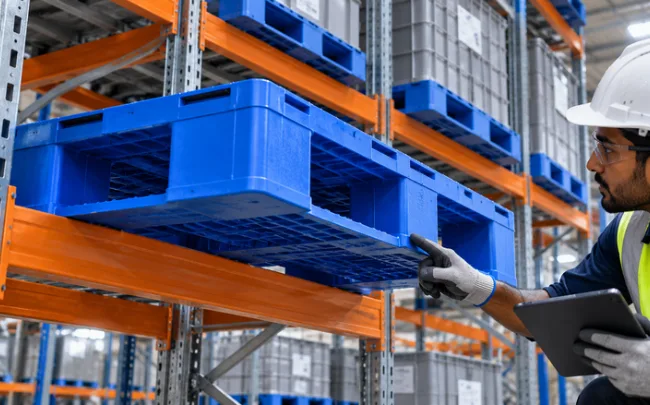
The base meets conveyor rollers and rack supports, so two pallets with identical outer dimensions can behave very differently on the same equipment. Ask for a base drawing and hold it against your conveyor and rack drawings. The producer also lists pallet boxes, but the figures below cover pallets only.
Reading Static, Dynamic and Racking Loads
Each pallet lists loads in up to three categories. Static is the weight carried while the pallet sits still. Dynamic is the weight while it moves. Racking is the weight while it rests on rack beams.
For a conveyor, the dynamic figure is the one to watch. For storage positions in an ASRS, look at racking. Here is what the listed pallets show, all at 1200 × 1000 mm:
| Pallet | Static | Dynamic | Racking |
|---|---|---|---|
| 3 Runner Pallet (150 mm high) | 4000 kg | 1000 kg | Not applicable |
| 3 Runner Flat Pallet (150 mm) | 5000 kg | 2000 kg | 1250 kg |
| 6 Runner Pallet (150 mm) | 6000 kg | 1500 kg | 750 kg |
| 6 Runner Flat Pallet (160 mm) | 6000 kg | 2000 kg | 1250 kg |
How Plastic Pallet Containers Meet Conveyors and ASRS
Compatibility comes down to three checks, done side by side. Footprint and height go against the equipment’s stated pallet size. The load category goes against the task; dynamic for conveyor travel and racking for stored positions. The base design goes against the supports it will rest on.
Equipment makers publish pallet requirements, and a plastic pallets supplier publishes ratings. Put both documents side by side and compare them line by line.
If your dimensions do not match, plastic pallet manufacturers in UAE may offer a route. One producer lists custom sizes for warehousing, cold storage and heavy freight. Whether a specific size is possible is a question for that manufacturer, so send your drawings with the enquiry.
Material, Temperature and Certification Notes
The listed pallets are made from HDPE or PP, and the producer describes its products as chemically resistant and recyclable. That is a useful background, but it does not prove a pallet will behave on a particular conveyor. For plastic pallet containers headed into a chilled ASRS, ask for temperature range data. Cold chain is one of the sectors this producer serves, so the question is a fair one.
The producer holds ISO 9001:2015 certification through WRG Certifications, a detail some buyers look for when comparing plastic manufacturers in UAE. It covers quality management in plastic trading, which speaks to processes, not conveyor or ASRS suitability. Reading a certificate’s stated scope takes two minutes.
Checks to Run Before You Order
Load ratings affect worker safety, so any gap between a rating and your real load is a reason to stop and ask.
- Ask for dynamic and racking figures for the exact model in writing.
- Request a base drawing and height tolerance to compare against your equipment.
- If the system is chilled, confirm the operating temperature range.
- Send conveyor and rack drawings with any custom size enquiry.
- Trial a small batch on your own line before committing to volume.
Final Thoughts
Plastic pallets can fit automated lines, but the proof sits in the paperwork before it sits on the floor. Footprint, base design and the right load category tell you far more than a photo does. Multibox lists static, dynamic and racking figures for the pallet models reviewed here, so teams can compare them against their own drawings. When you set your conveyor and rack specifications besides those ratings, which number looks like the weak link?
FAQ
Sometimes, yes. It depends on the base design, the footprint and the dynamic load rating, compared against what your conveyor maker asks for. Published specs help build a shortlist, but a small trial on your own line gives the real answer.
Start with the racking load. One 6-runner model lists 750 kg, while a 3-runner flat model lists 1250 kg. Your ASRS supplier’s requirements and an engineer’s review should decide the match, not a brochure.
Static is a loaded pallet sitting still, dynamic is it being moved, and racking is resting on rack beams. A pallet can look strong in one situation and modest in another.
One UAE producer lists custom sizes for warehousing, cold storage and heavy freight. Send your conveyor and rack drawings with the question, and ask for the load ratings of the finished size.
The listed pallets use HDPE or PP, and the producer lists chemical resistance and recyclability. Temperature range and load data still need checking before a pallet goes into chilled automation.