
Export Boxes Packaging: How UAE Manufacturers Ship Safely
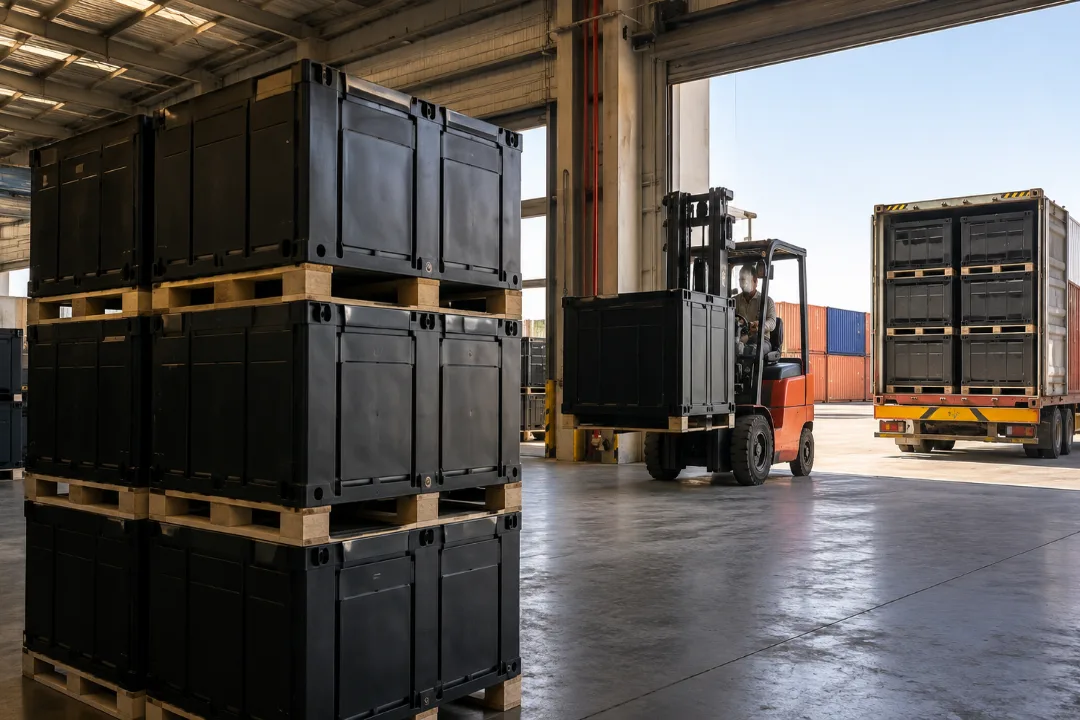
Export boxes packaging leaves the Sajaah Industrial Area in Sharjah every week, loaded onto trucks bound for ports across the Gulf and beyond. For a manufacturer sending goods to more than a dozen countries, the container that gets the product there intact matters almost as much as the product itself. Multibox, one of the plastic manufacturers in UAE working from this facility, has been supplying that container for over 13 years.
Table Of Contents:What Do Plastic Manufacturers in UAE Build Export Boxes Packaging For?
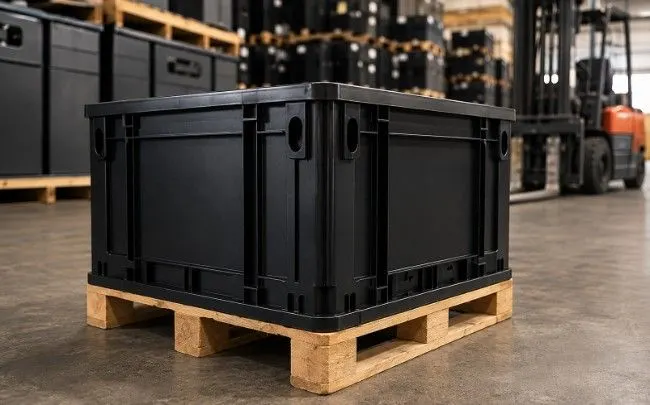
A pallet box is not a crate with taller walls. It is a rigid, HDPE structure designed to hold weight from above and below at the same time, so it can be stacked, racked, and moved by forklift without losing shape under load. Multibox produces two configurations: closed export boxes packaging for goods that need full containment and ventilated pallet boxes for cargo that needs airflow to stay fresh in transit.
Both are built from high-density polyethylene, which brings three practical qualities that matter for export. The material is chemically resistant, so it holds up against cleaning agents and the occasional spill. It is food-safe, which opens the door to produce, dairy, and packaged food shipments. And it is recyclable, a detail that increasingly shows up in procurement checklists for buyers in Europe and parts of the GCC.
Pallet Boxes That Handle the Realities of International Freight
A shipment rarely travels in a straight line. Goods get lifted onto a truck, unloaded at a warehouse, restacked for consolidation, loaded into a container, and unloaded again at the destination port. Every one of those touchpoints puts stress on the packaging.
This is why loading capacity ratings matter more than most buyers realize. Multibox lists static, dynamic, and racking capacities separately for its pallet boxes, at roughly 4,500 kg static, 1,000 kg dynamic, and 500 kg racking. Static load covers what the box can bear while stationary and stacked. Dynamic load covers what it can safely carry while being moved. Racking load covers what happens when the box sits on a warehouse rack rather than on the floor. A box rated only for static weight can fail the moment a forklift picks it up, so checking all three figures before ordering saves a costly surprise at the destination warehouse.
Sizes and Load Capacity Worth Checking Before You Order
Multibox offers its pallet boxes in two outer footprints: 1200 L x 1000 W x 760 H mm and 1200 L x 800 W x 760 H mm. The larger size holds an inner capacity of 610 liters, while the compact version holds 470 liters. Both share the same 760 mm height and use the same HDPE construction, so the choice usually comes down to how the box needs to fit inside a container or on a specific pallet footprint.
The 610L version measures 1100 L x 910 W x 600 H mm inside, and the 470L version measures 1100 L x 710 W x 600 H mm inside. Getting this number wrong at the planning stage is a common reason shipments end up under-filled or over-packed.
Why Exporters Increasingly Choose Plastic Over Wood
Wood pallets and crates crossing international borders generally fall under phytosanitary rules that require heat treatment or fumigation before they can be shipped, along with an official compliance mark on the packaging. <cite index=”3-1″>Methyl bromide fumigation for wood packaging material requires a minimum temperature of at least 10°C and a minimum exposure time of 24 hours</cite>, and treatment facilities need separate accreditation to apply the required stamp. That process adds cost, adds time, and creates a rejection risk if the marking is missing or incorrect at the border.
A plastic pallet box is not made from raw wood, so it generally sits outside this treatment requirement. That said, import rules vary by country and by commodity, so an exporter working across 15 or more markets should still confirm current requirements with their freight forwarder or the destination country’s plant protection authority rather than assume every border treats plastic packaging the same way.
Matching the Pallet Box to the Cargo
Ventilated pallet boxes suit fresh produce, dairy, and anything moving through a cold chain, since airflow reduces condensation buildup during transit. Closed pallet boxes suit pharmaceutical components, automotive parts, and retail back-end stock where containment and protection from dust matter more than airflow. Businesses also handling liquid drums or chemical containers alongside their pallet boxes often pair them with Multibox’s spill pallet range, which uses a similar closed structure built for containment rather than movement.
Final Thoughts
Choosing between a closed and a ventilated pallet box, and matching the right load rating to how the cargo actually travels, prevents most of the damage claims that surface after a shipment lands. What does your current export packaging struggle with most: load capacity, ventilation, or fit inside the container?
FAQ
Numbers help here more than opinions. Multibox lists three separate load ratings: about 4,500 kg static, 1,000 kg dynamic, and 500 kg racking. The gap between those figures is the real story, since a box built to hold weight while sitting still can still buckle the moment a forklift lifts it.
Not because of the plastic itself. Wood packaging carries fumigation and marking rules under international phytosanitary standards, and plastic pallet boxes packaging typically fall outside that requirement. Customs paperwork still depends on what’s inside the box, though, so check with your freight forwarder before assuming nothing applies.
Airflow, mostly. Closed boxes seal cargo completely, which suits automotive parts or pharmaceutical stock that needs protection from dust and moisture. Ventilated versions have gaps built into the walls, so produce and dairy shipments can breathe during longer transit windows without trapping condensation inside.
That’s what the racking rating is for. HDPE construction holds its shape under sustained weight, provided the stack stays within the limits listed for that specific box size. Push past those numbers, and even a well-made box will eventually deform or crack under pressure.
Outer dimensions tell you if it fits the container. Inner dimensions tell you how much product actually goes inside, and the two aren’t the same. Multibox’s larger box holds 610 liters with roughly 100 to 190 mm shaved off each inner wall, so measure before you pack, not after.