
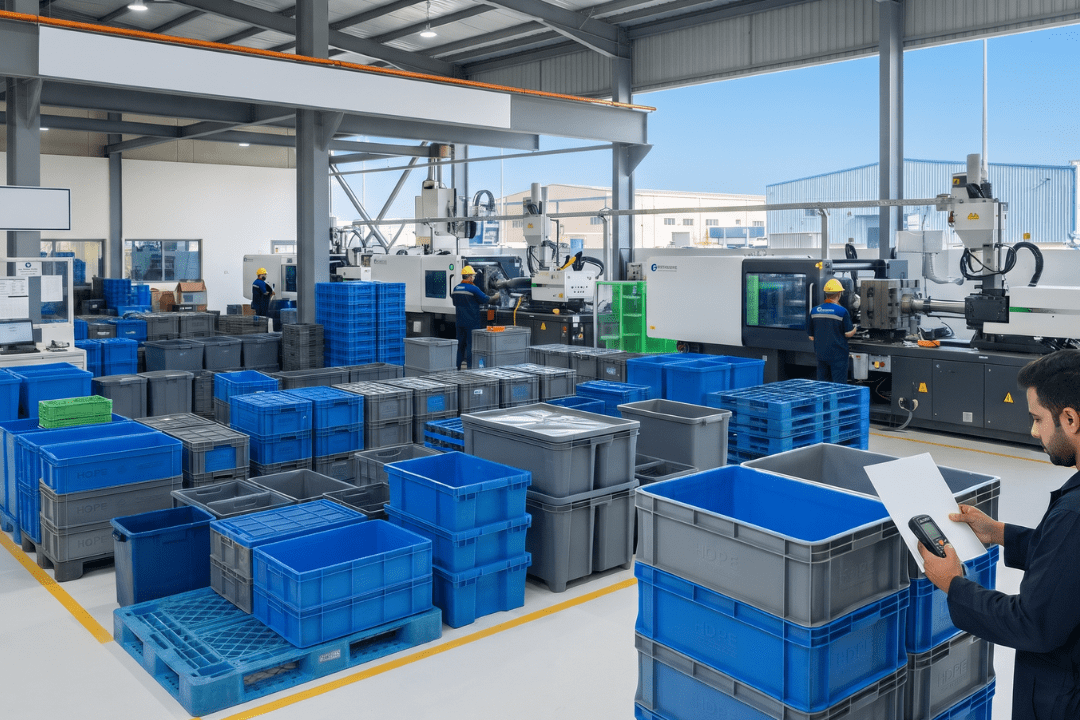
Emirates Plastic Industries Factory Standards Explained
Ask five UAE facility managers how they picked their plastic crate supplier, and the answers rarely match. Before comparing prices, the sharper question is what an Emirates plastic industries factory needs to prove before it earns a repeat order.
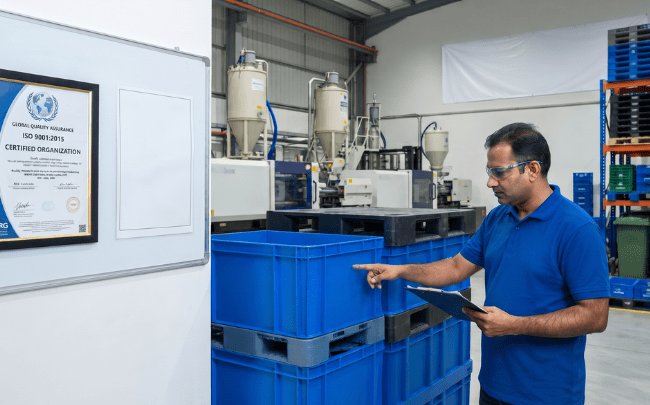
Sajaah Industrial Area in Sharjah houses several injection molding operations, and Multibox, a plastic manufacturer that has run there for more than thirteen years, is one of the few in the region holding ISO 9001:2015 certification issued by WRG Certifications for its quality management practices. That single credential is a useful starting point for judging any supplier in this category, though it is only a starting point.
Table Of Contents:
What Does ISO Certification Tell You About Plastic Manufacturers in UAE?
ISO 9001:2015 is a quality management standard, not a stamp on the plastic itself. It confirms that a factory has documented, repeatable processes for production, inspection, and corrective action, which matters once you are ordering thousands of crates a month and need consistency between batches rather than a one-off good run.
For plastic manufacturers in UAE, this distinction gets blurred in marketing copy fairly often. A supplier might say “ISO certified” without naming the certifying body or the specific standard. Multibox publishes both details, along with a physical address in Sajaah Industrial Area, which is a reasonable baseline to expect from any factory before signing a bulk order. Regulatory context also helps here. The UAE’s own standards body sets separate requirements for specific product categories, so ISO 9001 and any product-level UAE approval are not interchangeable. A factory that only mentions one and not the other is worth a follow-up call, particularly if your order is going into a food handling or pharmaceutical setting where traceability questions come up later.
Load Ratings and Materials Worth Checking Before You Compare Suppliers
Search for the best plastic pallets supplier in UAE and most results lead with price or delivery speed, not the numbers that actually matter for warehouse safety. Certification alone does not tell you whether a pallet will hold your load. Static, dynamic, and racking capacities differ by product, and the real numbers usually sit on the manufacturer’s own spec sheet rather than the homepage. A 3-runner flat pallet from Multibox, for example, is rated for 5,000 kilograms static and 2,000 kilograms dynamic. A 2-drum spill pallet in the same range carries a 230-liter sump capacity, built to contain leaks from two 205-liter drums.
Material matters just as much as load rating. Multibox manufactures its crates, bins, and pallets from high-density polyethylene or polypropylene, both food-safe and chemically resistant, with UV stabilizer added to closed crates meant to sit outdoors. Ask any factory you are comparing whether their material grade is disclosed specifically. If a spec sheet only says “durable plastic,” that is a gap worth flagging, not a detail to skip past.
Product Range and Customization Across the Category
Scale is another marker worth checking. Multibox lists more than 500 products spanning regular crates, series crates, plastic pallets, spill pallets, pallet boxes, spare parts bins, waste bins, cleaning trolleys, cool boxes, dairy crates, ingredient bins, and jerry cans, drums and IBC tanks. These serve sectors ranging from cold chain and food processing to pharmaceutical and automotive handling. A factory with a narrower catalogue may still suit a single product need, but a wider range usually points to more mature tooling and injection capacity behind it.
Custom sizing is where many comparisons actually get decided. Multibox builds crates and pallets to specific dimensions on request rather than only stocking fixed sizes. That is worth confirming with any supplier before assuming your storage racks or cold room shelving will fit their standard mold, since a near-match is not the same as an exact one. It also affects lead time. A stock item ships from existing inventory, while a custom mold or a modified cavity tool adds production days that a factory should quote upfront rather than after the order is placed.
Where an Emirates Plastic Industries Factory Fits the Comparison
Multibox has operated for over thirteen years, works with more than 1,000 customers, and exports to over fifteen countries from its Sharjah base. Track record is not a substitute for checking current certificates and specs directly, but a factory with a long operating history and export volume of that size has had more chances to standardize its processes than a newer entrant still working out its production line.
None of this replaces due diligence on your end. Request the current ISO certificate by name and number, ask which standards apply to the specific product you need, and get load figures confirmed in writing before committing to a bulk order. If a factory hesitates to share any of these three items directly, treat that as data too.
Final Thoughts
Comparing an Emirates plastic industries factory against its competitors comes down to three checkable things: verifiable certification, disclosed material and load data, and a product range that actually matches your operation. A supplier’s product catalogue, listed with dimensions and capacity alongside each item, is a more useful place to start than a homepage claim. What does your current supplier disclose upfront, and would you be comfortable asking them for the rest?
FAQ
Honestly, no. What ISO 9001 checks is the system behind the plastic, not each individual crate rolling off the line. Think documented steps, inspection logs, and someone accountable when a batch goes wrong. A pharma or food client should still ask for separate product test reports. The certificate alone won’t cover that.
Start with the current ISO certificate and its certifying body, then the static and dynamic load ratings for the exact pallet model, the material grade, and the real lead time. Get these figures in writing rather than relying on a general product description on a website.
Both handle low temperatures reasonably well, but the right pick depends on impact resistance and chemical exposure in your facility. Most factories, Multibox included, offer both across their crate lines, so the practical move is comparing the two for your load and temperature range rather than choosing by material name alone.
Most factories will say yes, and Multibox does offer this. But “custom” can mean a lot of things. Ask specifically whether it’s a new mold, a modified cavity, or just a color change, because those three come with wildly different timelines. A modified cavity might add a week. A brand new mold can add a month or more.
Runner count affects how a pallet handles racking and uneven floor loads. A 3-runner flat pallet from Multibox carries a 5,000-kilogram static rating, while the 6-runner version rises to 6,000 kilograms static with added racking support. Choose based on whether your warehouse uses rack storage or floor stacking.