
Plastic Products Manufacturers in Dubai: A Buyer’s Guide
Anyone sourcing plastic products manufacturers in Dubai runs into the same problem fast. The market is full of resellers and importers and a much smaller number of businesses that actually mold the product themselves. That difference shows up later, in lead times; in whether a crate dimension holds steady across a repeat order of ten thousand units; and in who picks up the phone when a batch doesn’t match spec.
Table Of Contents:
How Do Plastic Products Manufacturers in Dubai Source HDPE and PP?
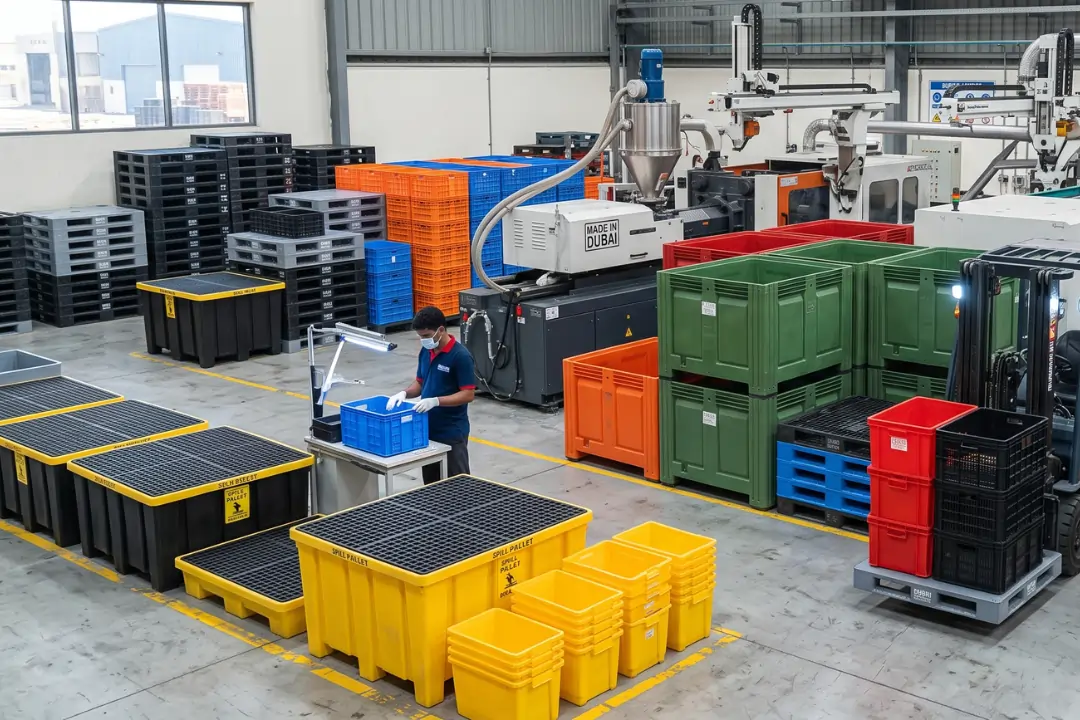
Most industrial crates, pallets and bins sold across the UAE are built from one of two materials: high-density polyethylene or polypropylene. Manufacturers such as Multibox, an ISO 9001:2015-certified producer based in Sharjah, run injection molding lines that shape both materials into food-grade and industrial-grade products. The ISO certification itself isn’t just a badge.
A facility working across 500-plus product types, serving over a thousand customers in more than 15 countries, tends to have tighter tolerances than a small workshop running one mold. That scale matters less for a one-off order and more for anyone planning repeat shipments over years.
Crates: Material Choices and Where Each Type Fits
Crate design changes a lot depending on what’s going inside it. Ventilated crates, with slotted sides for airflow, are standard for fresh produce, dates and bakery goods where trapped heat speeds up spoilage. A typical ventilated crate for produce runs around 585 mm by 385 mm by 210 mm and holds close to 48 litres. Closed crates, by contrast, seal the load and suit document storage, spare parts or anything that needs protection from dust and moisture rather than airflow.
Specialty crates exist too. Poultry transport uses a wider, shallower crate built for airflow and animal welfare during short-haul moves. Fish crates go the opposite direction, fully enclosed and sized for wet, chilled cargo. Anyone comparing suppliers should ask for exact dimensions and payload figures rather than trusting a category name alone, since “crate” covers a wide range of specs.
Pallets: Runner Configurations and Load Ratings
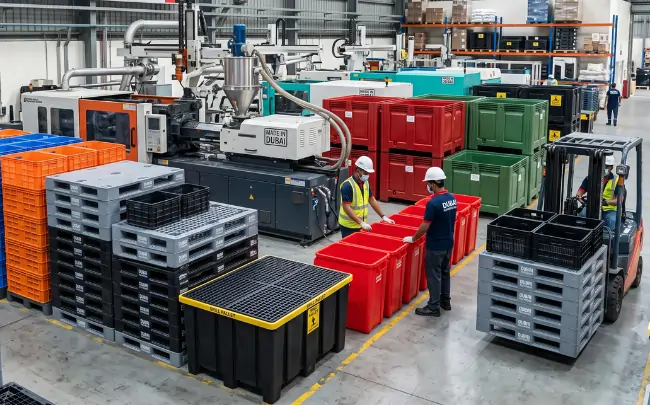
Plastic pallets in the UAE market usually come in 3-runner or 6-runner configurations, and the runner count changes the load rating more than most buyers expect. A standard 1200 mm by 1000 mm 3-runner pallet might carry a static load of 4,000 to 5,000 kilograms but only 1,000 to 2,000 kilograms dynamically, which is the figure that matters once the pallet is moving on a forklift rather than sitting still in storage. 6-runner pallets push static capacity higher, often to 6,000 kilograms, and are the more common choice for racking systems in cold storage or bulk warehousing.
Racking load, static load and dynamic load are three separate numbers, and a supplier quoting only one of them isn’t giving the full picture. Ask for all three before signing off on a pallet spec for a racked warehouse.
Bins, Spill Containment and Other Handling Products
Beyond crates and pallets, the same manufacturers typically produce waste bins, spare parts bins and spill pallets. A 1100-litre industrial waste bin, for example, might carry a payload of around 1,000 kilograms while weighing roughly 125 kilograms empty, figures that matter for anyone calculating fleet or facility waste logistics. Spill pallets serve a narrower but critical purpose: containing leaks from drums in industrial or chemical storage settings. A 2-drum high-floor spill pallet typically holds a sump capacity of around 230 litres, built to contain a spill from two 205-litre drums before it reaches the floor.
Material properties matter here too. The British Plastics Federation resource on HDPE and PP material properties breaks down why these two polymers dominate industrial handling equipment, covering chemical resistance and structural durability in more technical depth than most supplier catalogues bother with.
The plastic pallet range shows static, dynamic and racking figures side by side, and the spill containment pallet section lists sump capacity against drum count, so a buyer can match the number to the actual shelf or floor space they’re working with rather than guessing from a product photo.
Final Thoughts
Sourcing from plastic products manufacturers in Dubai comes down to matching the product spec to the actual job, not the other way around. A crate that’s perfect for bakery transport will underperform in a cold chain setting, and a pallet rated for static racking might fail under dynamic forklift loads it was never built for. What’s the load your operation actually needs to hold, moving or standing still?
FAQ
Genuine manufacturers run their own injection molding facilities, usually in industrial zones like Sharjah, rather than importing finished stock. Ask a supplier directly whether they mold in-house or resell from a third party. It changes lead times, customisation options and who’s accountable if a batch doesn’t match spec.
Sharjah’s industrial zones host most of the actual molding, Multibox among them, running injection lines rather than importing finished stock from overseas. A reseller will often quote the same price as a manufacturer and take the same three weeks to deliver, so price and lead time alone won’t tell you which one you’re dealing with. Ask who owns the mold. That single question usually settles it.
Sharjah’s industrial zones host most of the actual molding, Multibox among them, running injection lines rather than importing finished stock from overseas. A reseller will often quote the same price as a manufacturer and take the same three weeks to deliver, so price and lead time alone won’t tell you which one you’re dealing with. Ask who owns the mold. That single question usually settles it.
Custom molds cost real money upfront, so most manufacturers set a minimum order before they’ll cut a new dimension for you, often somewhere in the low thousands of units depending on the crate or pallet size. A first custom run also takes longer than a standard catalogue order, sometimes an extra four to six weeks for tooling alone. Get that timeline in writing before you commit a warehouse layout to a size that doesn’t exist yet.
Yes, though it’s not a guarantee of perfect quality on every single batch. It signals a documented quality management process is in place and gets audited by an accredited body. Worth confirming which certification body issued it and whether the certificate is current, since some suppliers display outdated badges.