

Upgrade to a Heavy-Duty Commercial Ingredient Bin
Efficiency in a high-volume facility isn’t about working harder; it’s about moving smarter. If your floor staff is still wrestling with 50 lb bags of raw materials or dealing with cracked, generic tubs, your workflow is leaking profit. A professional-grade commercial ingredient bin isn’t just a bucket on wheels—it’s a precision tool for inventory management.
At Multibox, we’ve outfitted massive processing plants and distribution hubs. We know that the wrong storage choice leads to cross-contamination and wasted man-hours. Here is how to pick gear that actually stands up to industrial abuse.
Table Of Contents:
| No | Contents |
|---|---|
| 1 | |
| 2 | Built for the Toughest Industries |
| 3 | The Logistics of Lid Selection |
| 4 | Right-Sizing Your Bulk Inventory |
| 5 | Final Thoughts on Commercial Ingredient Bin |
| 6 | FAQ |
Why Mobile Storage is Non-Negotiable
Movement is the backbone of any warehouse. Whether you are handling chemicals, pharmaceutical powders, or bulk food components, you can’t have stationary bottlenecks. A commercial ingredient bin with industrial-strength casters allows your team to transport 100 kg of material with a single hand.
The secret? Look for non-marking, heavy-duty wheels. In a fast-paced environment, you need wheels that glide over floor joints without stuttering. If a wheel locks up under a full load, you’re looking at a workplace safety hazard, not just a minor delay.
For facilities that also handle liquids, chemicals, or hazardous materials, proper containment is just as critical as mobility — explore our guide on spill pallet suppliers in UAE to ensure safe, compliant storage.
Built for the Toughest Industries
Food processing and pharmaceutical manufacturing share a common enemy: “dead zones.” These are the sharp corners in cheap bins where material gets trapped and rots or spoils. Your ingredient bin must have seamless, radiused internal corners.
In the chemical or textile industry, the focus shifts to impact resistance. You need high-density polyethylene (HDPE) or reinforced polypropylene. These materials won’t shatter if they take a hit from a pallet jack or a forklift.
For broader industrial storage organisation beyond food materials — such as managing components, tools, and parts in warehouses and factories — see our guide on spare parts bins and storage solutions in UAE to learn how they can keep your workspace tidy and accessible.
The Logistics of Lid Selection
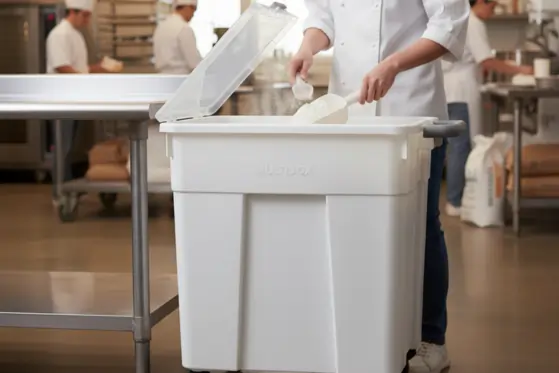
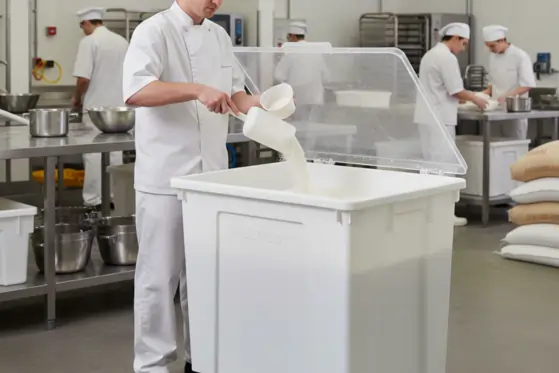
Visibility equals speed. If a worker has to crack open a lid to verify the contents, they are inviting dust and contaminants inside. Clear, sliding lids are the industry standard for commercial kitchen organization and industrial prep. They allow for an instant stock count without breaking the seal.
Sliding mechanisms are also superior to flip-tops in tight aisles. They don’t require vertical “swing room,” allowing you to stack racking closer together or fit bins under lower mezzanine levels.
Right-Sizing Your Bulk Inventory
Don’t fall into the “bigger is better” trap. Buying a bin that dwarfs your weekly turnover leads to “dead stock” sitting at the bottom for months. This is how quality control issues start.
Measure your standard bulk delivery units. Your bin should comfortably house a full shipment plus a 10% buffer. Most importantly, check the height. A standard commercial ingredient bin should slide under your existing workstations to keep aisles clear and trip-free.
When inventory volume is smaller or requires temperature control rather than bulk dry storage, insulated tub storage solutions in UAE offer a practical alternative for protecting sensitive materials in industrial environments.
Final Thoughts on Commercial Ingredient Bin
Is your current storage setup helping or hurting your bottom line? High-quality bins reduce physical strain on your team and protect your raw materials from environmental damage. Think about your floor layout. Does your bin choice eliminate “friction points” in your daily cycle? If the answer is no, it’s time to retool.
FAQ
Absolutely. We use high-impact, BPA-free polymers. They are designed to handle the “rough and tumble” of a loading dock, not just a quiet pantry.
It’s all about the seal. While these aren’t vacuum-sealed, a tight-fitting sliding lid keeps the worst of the humidity out. Pro tip: Don’t store your salt or sugar bins near open loading bay doors in the summer.
We don’t do “disposable” gear. Our casters are bolt-on. If one wears out after five years of heavy use, you just swap the part, not the whole bin.
Most of our industrial units are under 75cm high. They’re designed to tuck away so you aren’t tripping over them in the middle of a shift.